
Multi-Configuration ESD EVA Foam Tray: One Design for Three PCB Assembly Stages 2026-04-21

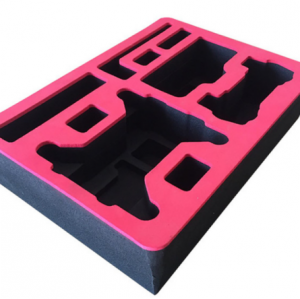
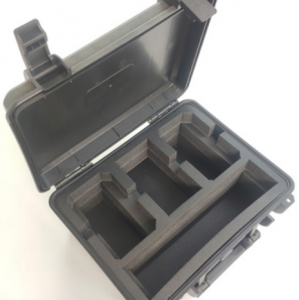
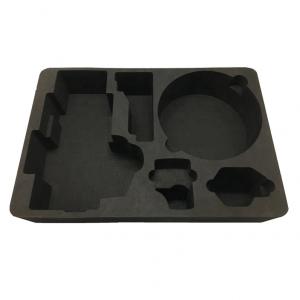
A global PCB assembly provider needed a single anti-static foam tray that could safely carry bare boards, plastic housings, and fully assembled modules on the same production line. Yufa Polymer engineered a 3-layer ESD EVA foam tray with Shore C 60° hardness to solve three problems at once.

The Challenge: Three Product Forms, One Tray

The customer operates high-mix assembly lines for compact electronic modules used in industrial control systems. At any given point on the line, the same product exists in one of three physical configurations:

  1. Bare PCB board — the unpopulated or partially populated printed circuit board, relatively thin and flat.
  2. PCB housing only — the molded plastic enclosure that the PCB will be inserted into, with a different weight but similar outer envelope.
  3. Fully assembled module — the PCB seated inside the housing, representing the final form factor with the highest weight of the three.

Previously, the line used three different tray designs — one per configuration. This created several operational headaches:

  • Tray changeover time — operators had to swap tray stacks whenever the line transitioned between assembly stages, adding non-productive minutes to every shift.
  • Inventory complexity — three separate tray SKUs had to be stocked, tracked, and reordered independently.
  • Mix-up risk — visually similar trays occasionally reached the wrong station, causing jams or component drops.

The customer asked Yufa Polymer whether a single ESD foam tray could handle all three configurations without compromising fit, protection, or static dissipation.

The Solution: High-Hardness EVA Foam with 3-Layer Laminated Construction

Why EVA Foam at Shore C 60°

Ethylene-vinyl acetate (EVA) foam was selected over XLPE for this application for several specific reasons:

  • High hardness availability — ESD EVA foam can be formulated to Shore C 60° and beyond, providing the rigidity needed for a reusable tray that must maintain its cavity geometry over hundreds of load/unload cycles. XLPE foam, while excellent for cushioning inserts, is typically softer and would deform under repeated use at these dimensions.
  • Structural integrity under weight variation — the three product configurations range from a lightweight bare PCB to a fully loaded assembled module. A Shore C 60° EVA foam tray maintains consistent cavity walls regardless of whether the seated component weighs 20 g or 150 g. Softer foams would compress asymmetrically under the heavier assembled module.
  • Clean die-cut performance at high hardness — EVA foam at this hardness level cuts cleanly with sharp, well-defined edges. This was essential for the cavity geometry, which needed to accept the PCB board in one orientation and the housing/assembled module in the same pocket.

Cavity Design: One Shape, Three Functions

The key insight that made the single-tray concept work was a careful analysis of the three product forms. Yufa Polymer's design engineers identified that:

  • The bare PCB has a smaller footprint and lower profile than the housing. It sits within the cavity with clearance on all sides, resting on the tray floor.
  • The housing (enclosure only) and the fully assembled module share identical outer dimensions. The only difference is weight — the assembled module contains the inserted PCB and is heavier.

This meant the cavity needed to be sized to the housing/assembled-module envelope, with the bare PCB naturally fitting within the same pocket. The Shore C 60° hardness ensured that even the lighter bare PCB would not rattle or shift excessively, because the rigid foam walls provide minimal deflection.

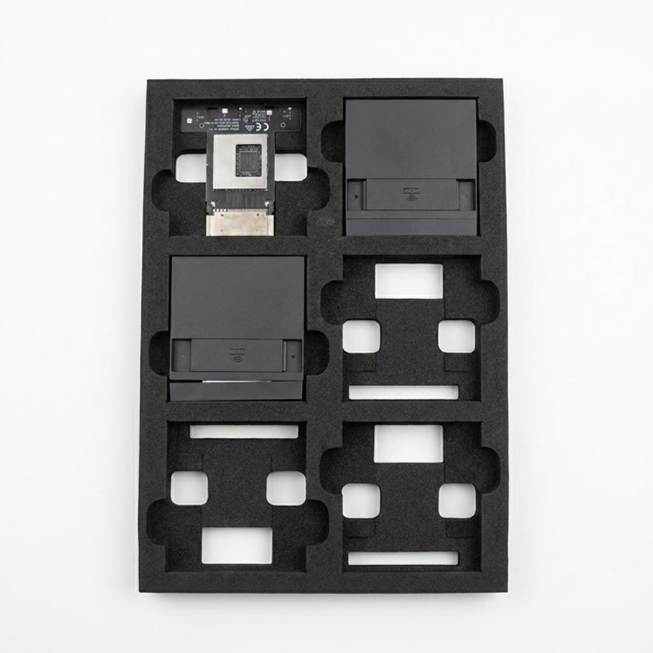
Design detail: Each tray holds 6 cavities across a 275×200 mm footprint. An 8 mm corner chamfer on the upper-right corner of each cavity (producing an 11.3 mm hypotenuse) serves as an orientation key, ensuring components are loaded in the correct rotational position every time.

3-Layer Laminated Tray Construction

The tray uses a total thickness of 20 mm, built from three distinct layers:

Layer

Thickness

Function

Top layer

12 mm

Contains the die-cut cavities that cradle the components. This is the primary functional layer.

Middle bonding layer

1.5 mm

Thin EVA sheet that bonds the top and bottom layers. Must be aligned precisely with no skewing to maintain cavity floor flatness.

Bottom layer

8 mm

Solid base providing structural rigidity and a flat stacking surface.

The 3-layer approach serves a critical function: the top layer's cavities are cut through the full 12 mm, but the middle bonding layer creates a sealed floor for each cavity. This is more dimensionally stable than trying to cut a blind pocket into a single 20 mm slab, because blind-pocket depth control in foam die-cutting is inherently less precise than through-cutting.

Bonding Alignment Control

The middle bonding layer required particular attention. A 1.5 mm sheet is thin enough that even slight misalignment during lamination would cause it to extend into the cavity opening or leave gaps at the cavity edges. Yufa Polymer used registration pins during the bonding process to hold all three layers in fixed alignment, ensuring the bonding layer sat straight with zero skew relative to the die-cut pattern above.

Results and Benefits

  • Tray SKU reduction from 3 to 1 — the customer eliminated two tray variants from their inventory, simplifying procurement, storage, and line-side logistics.
  • Faster line changeover — operators no longer need to swap tray stacks between assembly stages. The same tray flows through the entire line from bare-board insertion to final-module output.
  • Consistent ESD protection — surface resistance of 105–109 Ω across all tray surfaces, protecting sensitive PCB components from electrostatic discharge at every stage.
  • Orientation error prevention — the asymmetric corner chamfer makes incorrect component placement immediately obvious to operators, reducing quality escapes.
  • Durable for reuse — the Shore C 60° EVA foam resists compression set over repeated cycles, maintaining cavity dimensions throughout the tray's service life.

Technical Specifications

Parameter

Specification

Material

ESD EVA foam (ethylene-vinyl acetate)

Color

Black

Hardness

Shore C 60°

Surface Resistance

105–109 Ω

Tray Outer Size

275×200 mm

Total Thickness

20 mm (12 + 1.5 + 8 mm layers)

Cavities per Tray

6

Corner Chamfer

8 mm (11.3 mm hypotenuse), upper-right corner

Processing

Die-cutting + bonding (3-layer lamination)

Packaging

Carton

Application

PCB module assembly line turnover tray

Why ESD EVA Foam for Reusable Assembly Trays?

EVA foam is one of the most versatile materials in the ESD packaging toolbox, particularly when the application demands structural performance rather than pure cushioning. Here is what makes it well suited for reusable tray applications:

  • Wide hardness range — ESD EVA foam can be manufactured from Shore C 25° (soft, cushioning) up to Shore C 70° (rigid, load-bearing). This range means the same material family can serve as both a soft insert liner and a hard tray shell, depending on formulation.
  • Compression-set resistance at high hardness — at Shore C 60° and above, EVA foam retains its shape under sustained or repeated loading. This is what allows a tray to survive hundreds of cycles without cavity walls widening or floors sagging.
  • Good bonding characteristics — EVA accepts adhesive bonding well, which is essential for multi-layer constructions. The 3-layer design used in this project relies on strong, uniform interlayer adhesion to maintain structural integrity.
  • Cost-effective at volume — EVA foam is generally more economical than XLPE at comparable hardness levels, which matters for tray programs where hundreds or thousands of units are produced.

For applications where lower density, softer cushioning, or ultra-low dust generation are the primary requirements, XLPE foam may be the better choice. Yufa Polymer works with both material families and helps customers select the right one during the design consultation phase. See our comparison guide: ESD XLPE vs. EVA Foam — How to Choose the Right Material.


Wie können wir Ihnen helfen
Kontaktieren Sie uns in Ihrer Nähe oder stellen Sie online eine Geschäftsanfrage
Kontaktieren Sie uns
Heiße Produkte
Anpassen EVA Schaumkasten EVA Material Musterfarbe EVA Schaum Anpassen EVA Schaumkasten EVA Material Musterfarbe EVA Schaum
Anpassen EVA Schaum mit guter Flexibilität und gummiartiger Elastizität, Transparenz und Oberflächenglanz, gute chemische Stabilität, gut Anti-Aging und Ozonwiderstand und nicht toxisch bei -50 Grad Celsius.
Weiterlesen
Anpassen, EVA-Schaum Fach EVA-Material-Muster-Farbe-EVA-Schaum Anpassen, EVA-Schaum Fach EVA-Material-Muster-Farbe-EVA-Schaum
Anpassen, aus EVA-Schaumstoff mit guter Flexibilität und gummiartige Elastizität, Transparenz und Oberflächenglanz, gute Chemische Beständigkeit, gute anti-Alterungs-und Ozonbeständigkeit, und nicht-giftig bei -50 Grad Celsius.
Weiterlesen
 ESD EVA Schaum-Anti-statischer geschlossener Zellen-Schaumblock ESD EVA Schaum-Anti-statischer geschlossener Zellen-Schaumblock
Yufa EVA Schaum mit guter Flexibilität und gummiartiger Elastizität, Transparenz und Oberflächenglanz, gute chemische Stabilität, gut Anti-Aging und Ozonwiderstand und nicht toxisch bei -50 Grad Celsius. Yufa Mini-Arbeitstabelle zur Montage kleiner Geräte, die empfindlich für ESD sind.
Weiterlesen
eine Nachricht schicken
Wenn Sie Fragen oder Anregungen haben, hinterlassen Sie uns bitte eine Nachricht, wir werden Ihnen so schnell wie möglich antworten!
Willkommen zu CTFESD
Wenn Sie Fragen oder Anregungen haben, hinterlassen Sie uns bitte eine Nachricht, wir werden Ihnen so schnell wie möglich antworten!

Startseite

Produkte

Über

Kontakt